This article was published in the June 2025 issue of the SABR Black Sox Scandal Committee newsletter.
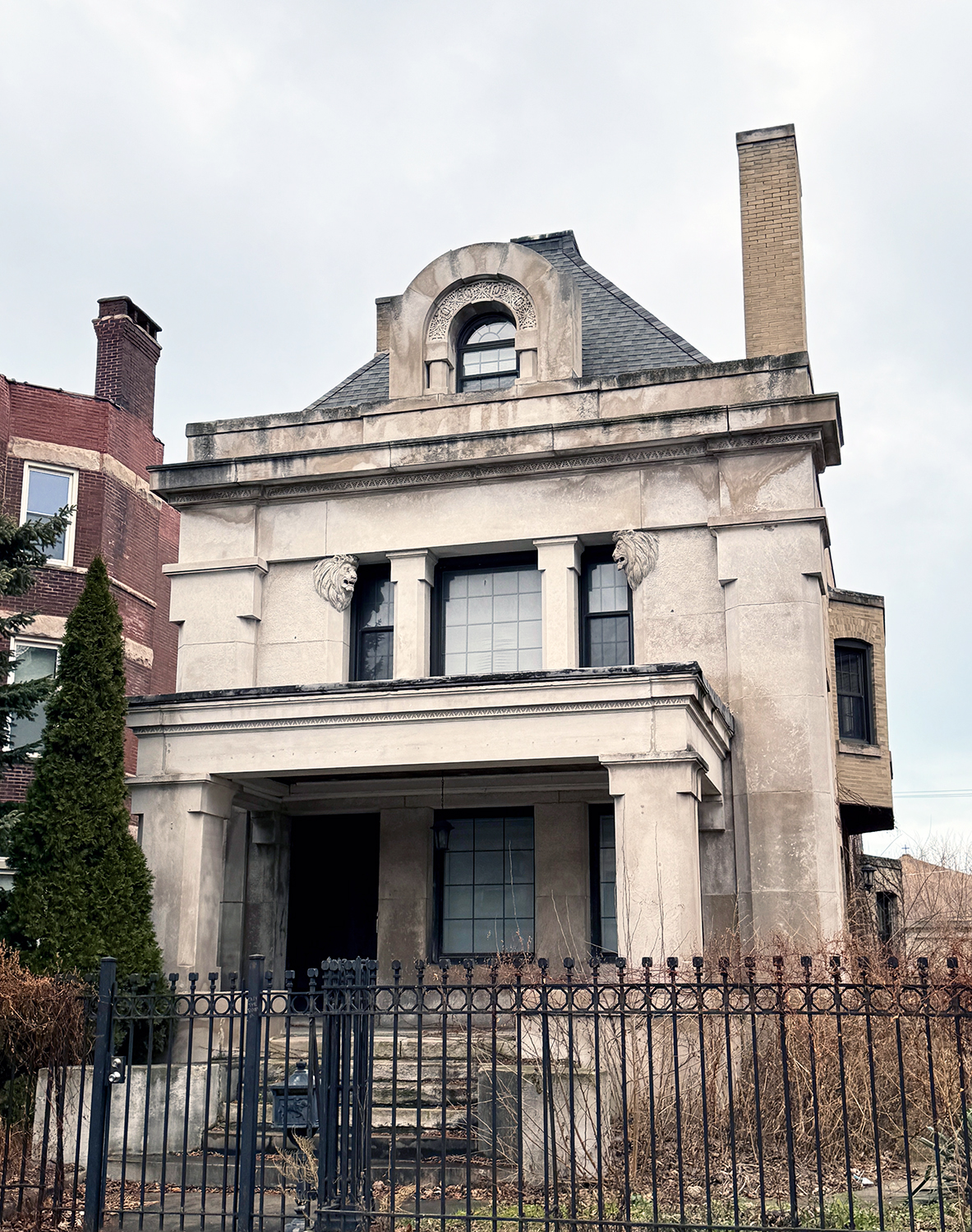
In 2003, a historic home once owned by Chicago White Sox owner Charles Comiskey was designated as a Chicago Landmark.
Designed by architect George W. Maher at the turn of the twentieth century, the 2½-story tan brick and gray limestone house at 5131 South Michigan Avenue in Chicago’s Washington Park community area is an important early work in Maher’s portfolio of Prairie School architecture. When it was honored by the city’s Commission on Chicago Landmarks, it was named the “Pate-Comiskey House.”
But Charles Comiskey did not live there for long, and the house is rarely mentioned in any accounts of his life. How did this Michigan Avenue mansion get saved from the wrecking ball nearly a century after the baseball pioneer resided there and why is his name enshrined in its records?

Construction Begins
In 1901, the same year that Comiskey’s Chicago White Sox began play as a major-league team in the American League, lumber baron Davey S. Pate bought a lot on Michigan Avenue, which was then considered to be “one of the most prestigious residential avenues on the South Side.”1 Both sides of Michigan Avenue were lined with elaborate homes built by the city’s top architects for its most influential business and civic leaders.
Pate hired 36-year-old George W. Maher, one of Chicago’s most innovative architects, to design his new home. Maher had trained with the noted architect Joseph Lyman Silsbee’s firm (where one of his coworkers was Frank Lloyd Wright) before opening his own firm in 1893, when the World’s Columbian Exposition brought an international audience to the city and business boomed for local architects.
For a building cost of $20,000 (nearly $700,000 in 2025 dollars), Maher produced a Prairie School masterpiece, a tan brick structure covered in smooth gray limestone. The house included a wide front porch, a distinctive arched dormer, two lions squaring off near the second-floor windows, and a decorative iron fence enclosing the property. The house’s design displayed Maher’s interest in “combining aspects of both traditional and modern architecture through its symmetry, grandly scaled yet starkly simple facade, visually bold use of limestone and unusual ornament. … Its visual simplicity and dignity … gives the building a great sense of presence.”2
Years before Maher designed Davey Pate’s house, he wrote an article for Inland Architect and News Record in which he described his ambition to create a uniquely modern American style through his buildings:
“If designed aright it presents a model for picturesqueness. Rock-faced base, porches plain and devoid of spindle work, long sweep of roof pierced with short, massive chimney … it tends to leave the impression of quietness of home rather than a dazed impression of grandeur. … This style of building suits the taste of a better class of American people.”3
These were all elements that later showed up in Pate’s house on Michigan Avenue and which came to characterize Prairie School architecture. Championed by Maher, Wright, and other Midwestern architects, the Prairie School was a movement to develop a uniquely American style that incorporated local materials and landscapes. These buildings were marked by simple, natural exteriors, flat roofs, and horizontal lines that evoked the wide prairie, a far cry from the more elaborate European or ancient Greek- and Roman-inspired designs that were popular during the mid-nineteenth century.
According to the Commission on Chicago Landmarks, Maher’s design was a significant early example of his “motif-rhythm theory of design, which used the form of an indigenous plant” combined with a geometric shape as its unifying theme.4 The house he designed for Pate used a stylized thistle as the basis for his ornamentation, a theme to which he would return in later projects.
Many of Maher’s surviving Prairie-style houses have been designated as Chicago Landmarks, including the King-Nash House in East Garfield Park and the Colvin House in Edgewater, as well as a cluster of homes in the North Shore suburb of Kenilworth, where Maher himself lived for many years. The home Maher built for John Farson in Oak Park, one of his earliest Prairie-style buildings, was added to the US National Register of Historic Places in 1972.
The British-born Davey Pate lived with his wife Catharine for ten years in the Michigan Avenue house, where their neighbors were also titans of industry, including real estate developer James W. Eastland, attorney and parks commissioner Gabriel Norden, and coal executive Harry Hafer.5 In 1911, Pate sold the house to Joseph and Clara Greenwald, who owned a furniture store on the South Side. The Greenwalds added a brick two-car garage behind the original house and raised their family there for the next decade.6
Comiskey Buys the Mansion
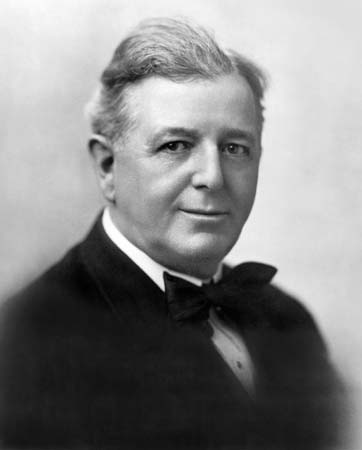
Before purchasing the Maher-designed home in 1922, Comiskey lived farther north on Michigan Avenue for many years.7 He spent the White Sox’s championship seasons — and rode out the Black Sox Scandal following the 1919 World Series — living at 3816 S. Michigan Ave., a brisk 20-minute walk away from his team’s ballpark on 35th Street.
Across the street at 3831 S. Michigan Ave. was a Georgian Revival mansion that later became home to the South Side Community Art Center, the nation’s first art museum devoted to Black artists. In 1941, First Lady Eleanor Roosevelt spoke at the art center’s dedication and in a national radio address mistakenly called that building the former home of Charles Comiskey, “who was once a great baseball magnate.”8 The art center was named as a Chicago Landmark in 1994 and listed on the National Register of Historic Places in 2018; Comiskey’s old home on the 3800 block was torn down for an apartment building.
In the spring of 1922, White Sox executive Harry Grabiner negotiated the purchase of Comiskey’s new home at 5131 S. Michigan Ave. from the Greenwalds. Grabiner paid a reported $22,500 sale price ($430,000 in 2025 dollars), then transferred the house to Comiskey “for a nominal consideration.”9 It’s unclear why Grabiner became involved as an intermediary or why Comiskey did not directly purchase the home himself.
Comiskey at the Maher Mansion
It’s unlikely that Charles Comiskey would consider 5131 South Michigan Ave. to be the site of many happy memories.
Just six months after he bought the home, his wife Nan died at the age of 58 in October 1922 after a long illness.10 The following summer, two “masked and armed” men entered the home while Comiskey’s daughter-in-law Grace and her sister Alice Reidy were inside, along with former White Sox star Ed Walsh. The burglars locked up the trio in the basement before ransacking the house, leaving with a diamond ring and other jewelry and cash valued at more than $8,000. Charles Comiskey was away at his summer estate in northern Wisconsin at the time.11
Comiskey’s own health had been deteriorating since before the disastrous 1919 World Series. He stopped attending baseball’s annual winter meetings and took more of a back seat to his son, J. Louis Comiskey, and Harry Grabiner in White Sox operations. Comiskey’s most significant move during his years living at 5131 S. Michigan Ave. was his decision to make a massive overhaul to the White Sox ballpark during the 1926-27 offseason, ripping out the old wooden seats and expanding the grandstand with an upper deck and a roof. Seating capacity increased from 28,000 to 52,000 when the ballpark reopened in the spring of 1927.12
By the following summer, Comiskey had moved away from Michigan Avenue for good.13 He took up residence at his son Lou’s home on Paxton Avenue in the South Shore neighborhood adjacent to Jackson Park, where the 1893 World’s Fair was held.14 Comiskey lived with Lou, Grace, and their family in his final years before his death at age 72 on October 26, 1931.

Preservation Efforts
As later generations of the Comiskey family moved farther away from Michigan Avenue, ownership of their one-time home reflected the South Side’s changing demographics. By the time of the Old Roman’s death in 1931, Washington Park was squarely in the Black Belt, one of the few areas in the city where African Americans were allowed to live due to discriminatory “red-lining” policies and restrictive real estate covenants.15
In the 1940s, the Maher house was bought by Lt. Col. Edward D. Wimp Jr., a decorated US Army soldier who saw combat in Italy with the segregated 93rd Field Artillery Battalion. At home, he was the commanding officer of an Illinois National Guard battalion. Wimp later married Kathryn McDonald Davis, a singer who toured with Duke Ellington’s orchestra, and helped form the first Black-owned corporation to own a McDonald’s franchise in Chicago.16
In the 1960s, many of the turn-of-the-century mansions that lined Michigan Avenue were torn down; some were replaced by public housing while other lots remain vacant to this day. Just a few blocks away from where Comiskey used to live, thousands of homes were destroyed for the construction of the Dan Ryan Expressway, which became a main thoroughfare for White Sox fans traveling to Comiskey Park.17
Charles Comiskey’s former home passed through a series of private owners into the 1990s, when it was identified as a “potentially significant” site in the Chicago Historic Resources Survey, a decade-long study of historic structures throughout the city.18 In 2002, historian Donald Aucutt confirmed the home was a George W. Maher design, praising the “exceptional” limestone exterior, which brought renewed attention from a city full of architecture enthusiasts.19
The Commission on Chicago Landmarks took up the case from there, completing a report that identified the historic exterior, including the horizontal roof lines, and iron fence enclosure with Prairie-style decorative elements as the most significant features worth preserving. The report noted that the interior rooms had been “gutted by a previous owner” and retained “almost no historic detailing.”20
“My guess is the house was threatened with demolition in some way, and landmarking it is likely what saved it from the wrecking ball,” said Kevin Brown, founder of the George W. Maher Society. “Because the house was designed by a well-known and influential architect, is an excellent example of a mix of Prairie and European architecture and was once owned by someone famous, it meets at least two or three of the criteria for landmarking a structure in Chicago.”21
The Chicago City Council approved landmark status for the Pate-Comiskey House on October 1, 2003.22 In the ensuing years, the house has remained in private ownership; it was last sold for $235,000 in 2005 — the same year the White Sox won their first World Series since Comiskey owned the team. The house occasionally shows up on lists of historic Gilded Age mansions, although there is no marker attesting to its significance on the property.23 Meanwhile, the mansion directly across the street, which served for decades as a pioneering settlement house to welcome and educate Black women who moved to the city during the Great Migration, was included on Preservation Chicago’s list of “most endangered” sites in 2021.24

Acknowledgments
Special thanks to Chicago architectural historian Deborah Mercer; Ellen Keith of the Chicago History Museum; Keva Kreeger of the Newberry Library; and Kevin Brown of the George W. Maher Society for their assistance and guidance.
Notes
1 “Pate-Comiskey House Landmark Designation Report,” Commission on Chicago Landmarks, April 1, 2003. Accessed at Chicago History Museum. The report was researched and written by Terry Tatum.
2 “Pate-Comiskey House Landmark Designation Report.”
3 George W. Maher, “Originality in American Architecture,” Inland Architect and News Record, October 1887. Cited in “Pate-Comiskey House Landmark Designation Report.”
4 “Pate-Comiskey House Landmark Designation Report.”
5 1910 US Census, accessed at Ancestry.com. Catharine’s name was also spelled “Kathryn” in newspaper articles and city directories, but her obituary and other documents use “Catharine”. Pate’s neighbors were all included in Herringshaw’s City Blue Book of Biography: Chicagoans of 1916 (Chicago: Clark J. Herringshaw, 1916). So was Charles Comiskey.
6 Chicago Inter Ocean, February 15, 1911, 10; Chicago Tribune, May 23, 1920, 97.
7 According to the 1910 US Census and Chicago City Directories, Charles Comiskey lived at 3952 S. Michigan Ave. before briefly moving to 4358 S. Michigan Ave. and then in 1915 to 3816 S. Michigan Ave.
8 Eleanor Roosevelt, “My Day, May 9, 1941,” United Feature Syndicate, The Eleanor Roosevelt Papers Digital Edition (2017), accessed May 26, 2025, at https://www2.gwu.edu/~erpapers/myday/displaydoc.cfm?_y=1941&_f=md055882. The dedication ceremony was broadcast nationally on CBS Radio. The building that is now home to the art center was built in 1893 by grain merchant George Seavern.
9 Chicago Tribune, May 3, 1922, 28; Chicago Tribune, April 25, 1922, 23.
10 Sam Gazdziak, “Grave Story: Charles Comiskey,” RIP Baseball, September 18, 2020, https://ripbaseball.com/2020/09/18/grave-story-charles-comiskey/, accessed May 10, 2025.
11 “Rob Comiskey Home And Get $8,775 in Loot,” Chicago Tribune, August 27, 1923: 1. The $8,775 in value would be about $163,000 in 2025 dollars.
12 Philip J. Lowry, Green Cathedrals: The Ultimate Celebration of All Major League and Negro League Ballparks, Fifth Edition (Phoenix, Arizona: SABR, 2019), 77-79.
13 Comiskey also sold his beloved lakeside estate near Eagle River, Wisconsin, at the same time. In 1928, Joseph and Rena Pytlik purchased his property on the shores of Sand Lake. As of 2025, the family (which now spells their surname as “Pitlik”) still owns and operates the guest rooms and restaurant, known as Pitlik’s Sand Beach Resort. See https://pitliksresort.com/, accessed May 20, 2025.
14 Lou and Grace Comiskey lived at 6815 Paxton Ave., according to the 1928-29 Chicago City Directory and the 1930 US Census.
15 “A Brief History of Redlining,” Chicago History Museum, July 18, 2020; accessed on May 30, 2025 at https://www.chicagohistory.org/redlining/. For a comprehensive history of state-sponsored redlining practices, see Richard Rothstein, The Color of Law: A Forgotten History of How Our Government Segregated America (New York: Liveright, 2017).
16 “Names Officers to Combat Team,” Chicago Defender, March 8, 1947, 6. Chicago Sun-Times, April 19, 1991.
17 Despite making up 23% of Chicago’s total population in the 1960s, 64% of those displaced by the Dan Ryan Expressway’s construction were Black. Adam Paul Susaneck, “Segregation by Design.” TU Delft Centre for the Just City, 2024, accessed on May 30, 2025 at https://www.segregationbydesign.com/.
18 Chicago Historic Resources Survey, accessed on May 30, 2025, at https://webapps1.chicago.gov/landmarksweb/web/historicsurvey.htm.
19 Donald Aucutt, George W. Maher Quarterly, April-June 2002, accessed via the Internet Archive on May 30, 2025 at https://archive.org/details/george-w-maher-quarterly-2002/.
20 “Pate-Comiskey House Landmark Designation Report.”
21 Email from Kevin Brown, October 22, 2024.
22 Journal of the Proceedings of the City Council of the City of Chicago, Illinois, October 1, 2003, 8600-8603.
23 Andrew Schneider and Jay Koziarz, “Chicago’s greatest remaining Gilded Age mansions,” Curbed Chicago, February 13, 2020, accessed on May 30, 2025, at https://chicago.curbed.com/maps/gilded-age-historic-mansions-map.
24 “Phyillis Wheatley Home,” Preservation Chicago, March 4, 2021, accessed on May 30, 2025, at https://www.preservationchicago.org/phyllis-wheatley-home/.
 Jacob Pomrenke