This article was published in the June 2026 issue of the SABR Black Sox Scandal Committee Newsletter.
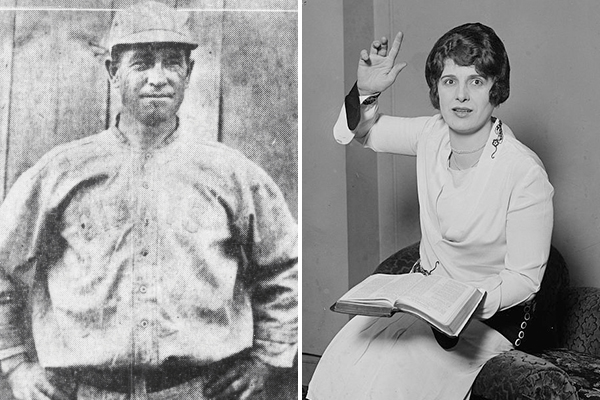
Five thousand cheering fans filled the ballpark in Douglas, Arizona, on a gloomy, gray Friday afternoon. A Copper League baseball game was scheduled on June 25, 1926, between the hometown Douglas Blues and the Chino Twins from New Mexico. Both teams employed former major league stars as their main attractions: Buck Weaver for Douglas and Chick Gandil for Chino. Both players were playing in this disreputable “outlaw” league because they had been banned for life from professional baseball following the Black Sox Scandal.
As the Douglas Daily Dispatch reported, “Hundreds of cars lined the curbs about the park, while thousands of eager listeners crowded about the [grand] stand. … Neither the heavy wind nor the rain which at periods fell rather heavily detracted from the gathering. The crowd was curious and the crowd was enthusiastic.”1
But these fans did not show up to the Tenth Street Ballpark in Douglas to see a ballgame, which had already been called off a day before.2 Instead, the main attraction was Sister Aimee Semple McPherson, the most famous religious figure in America.
The popular evangelist was making her first public appearance in the United States since she reportedly went missing nearly six weeks earlier while swimming at a beach in southern California. An intensive search effort in and around Los Angeles resulted in two deaths, of a deep-sea rescue diver and a despondent church member, but no trace of McPherson’s body was uncovered. Suddenly, on June 23, McPherson showed up alone at a house in Agua Prieta, Mexico, just across the international border from Douglas, claiming she had been kidnapped and held hostage for more than a month.3
As law enforcement officials, reporters, and curiosity seekers from two different countries converged on Douglas to investigate the spectacle, another one of baseball’s most infamous figures came up with his own game plan. Hal Chase — known as the most corrupt player in the sport for his extensive history of game-fixing and the man who recruited Weaver and Gandil to Arizona in the first place — decided he was going to extort the newly found preacher while she recuperated at the hospital.
What were the odds that all of these infamous figures would end up together in a dusty, desert copper mining town of fewer than 10,000 residents at the very edge of the United States?
The presence of the baseball players was easier to explain. Weaver, Gandil, and Chase had all been major league stars a decade earlier, but they were kicked out of professional baseball for their roles in fixing the 1919 World Series. Weaver and Gandil were members of the Chicago White Sox who conspired with gamblers to intentionally lose the World Series to the Cincinnati Reds, while Chase reportedly served as a liaison between the players and gamblers. By the mid-1920s, the Copper League was one of the few independent circuits available where they could still earn a living by playing ball. Most teams refused to give these banished players a look, but in an era when the closest major league team was in St. Louis, more than 1,000 miles away from Douglas, many fans in remote or rural towns welcomed a chance to see bona fide major leaguers up close.
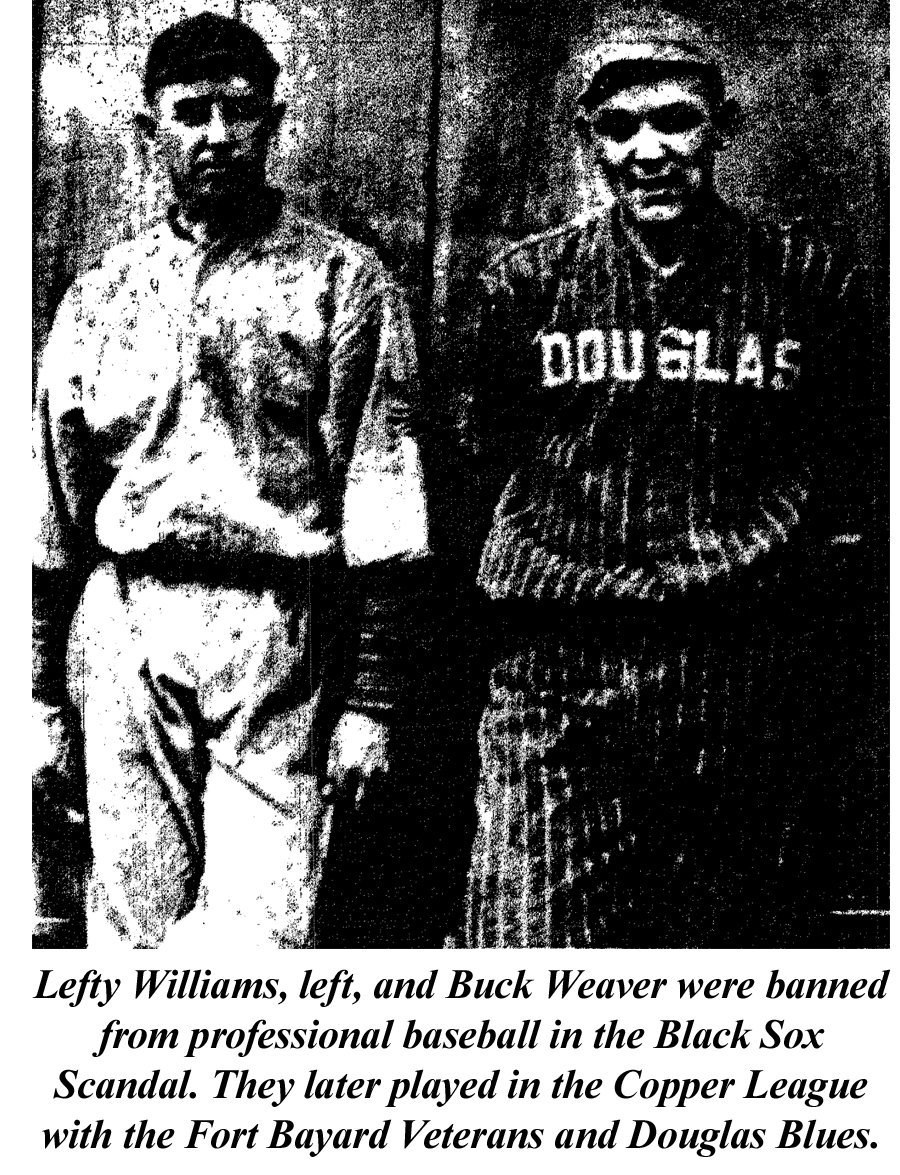
Chase recruited Weaver and Gandil to join him in southern Arizona in the summer of 1925.4 The following year, they all returned with a few more baseball outlaws in tow: ex-Black Sox pitcher Lefty Williams and New York Giants outfielder Jimmy O’Connell, recently banned for attempting to bribe an opposing Philadelphia Phillies player.5
Fans around the Copper League — with six teams in west Texas, southern New Mexico and Arizona, and Juarez, Mexico — enjoyed watching these talented “outlaw” players. But their teams struggled financially from the outset, relying on ticket sales, individual subscriptions, and a smattering of corporate support. Chase was making a reported $250 per month6 and, unlike the other players, he didn’t seem to hold a regular job on the days between games. League treasurer S.L.A. Marshall reported, “Roll into Douglas any morning at 6 o’clock and you’ll meet Chase on the streets. He’ll be strolling up and down in his shirt sleeves and smoking a big, black cigar. Nothing ever bothers Chase.”7
On the baseball field, Chase and Weaver provided plenty of highlights for Douglas, but a lack of pitching doomed the team to a lackluster record. Lefty Williams’s arm was out of shape when he first joined the Blues, and by the time he returned to form he had jumped to a new team in Fort Bayard, New Mexico. Meanwhile, his former White Sox teammate Gandil had jumped to the Chino Twins, based in nearby Hurley, New Mexico, after a feud with Jimmy O’Connell. Tired of Gandil “ragging” him every day, O’Connell picked up a baseball bat one afternoon and chased Gandil out of the ballpark for good.8 No one in Fort Bayard seemed to mind Gandil’s absence.
The second half of the Copper League season was scheduled to begin on Friday, June 25, but Sister Aimee’s surprise reappearance in Douglas overwhelmed everything else in town.
McPherson, a Canadian-born preacher who founded the Foursquare Gospel Church, frequently drew capacity crowds for her daily religious services in Los Angeles, which were broadcast on radio to thousands of listeners.9 She was the first religious figure in the United States to take advantage of new 20th-century technologies to spread her message.
“She was a spellbinding speaker,” author Matthew Sutton told the BBC News. “She knew how to use dramatic tricks to draw audiences, and so she turned out to be enormously popular. What made her most popular was her seeming ability to lay hands on the sick and to heal them.”10
When McPherson did not show up for her scheduled sermon on May 18 after taking a swim in the Pacific Ocean near Santa Monica, her faithful church followers led a weeks-long effort to find her. Newspaper headlines breathlessly reported sightings of the evangelist all over the country. A ransom note demanding $50,000 (about $925,000 in 2026 dollars) was sent to her mother, who doubled as her manager and business partner in the church.
Rumors circulated that McPherson, who was widowed from her first husband and divorced from her second, had staged her own kidnapping to cover up an affair with one of her radio engineers, who was married. Her mother believed she had drowned and staged a high-profile funeral at the Angelus Temple they had built together in downtown Los Angeles. Churchgoers added $36,000 to the collection trays that day.11
Nearly six weeks after McPherson went missing — and two days after her mother’s memorial service — a woman in a white dress showed up on the evening of June 23 at a house in Agua Prieta, Mexico, about 600 miles away from Los Angeles.12 The homeowner found a taxi driver to take her to a police station across the border in Douglas. The American officers took her to a hospital there, where she confirmed her identity as the famous missing preacher and called her mother. Then in a bedside interview, she told an increasingly bizarre story about her ordeal.
McPherson said she had been abducted from a crowded beach and eventually taken across the border to a remote Mexican shack, where her kidnappers awaited their ransom money. She claimed to have escaped through a window and walked about 20 miles in the stifling desert heat to safety. The nurses examining her found only a few small blisters on her toes, a couple cactus thorns on her ankles, and a fresh scar on her hand, where she said she had been tortured with a lit cigar.13 Not everyone believed her harrowing tale, including J.F. McDonald, the sheriff of Cochise County in Arizona.
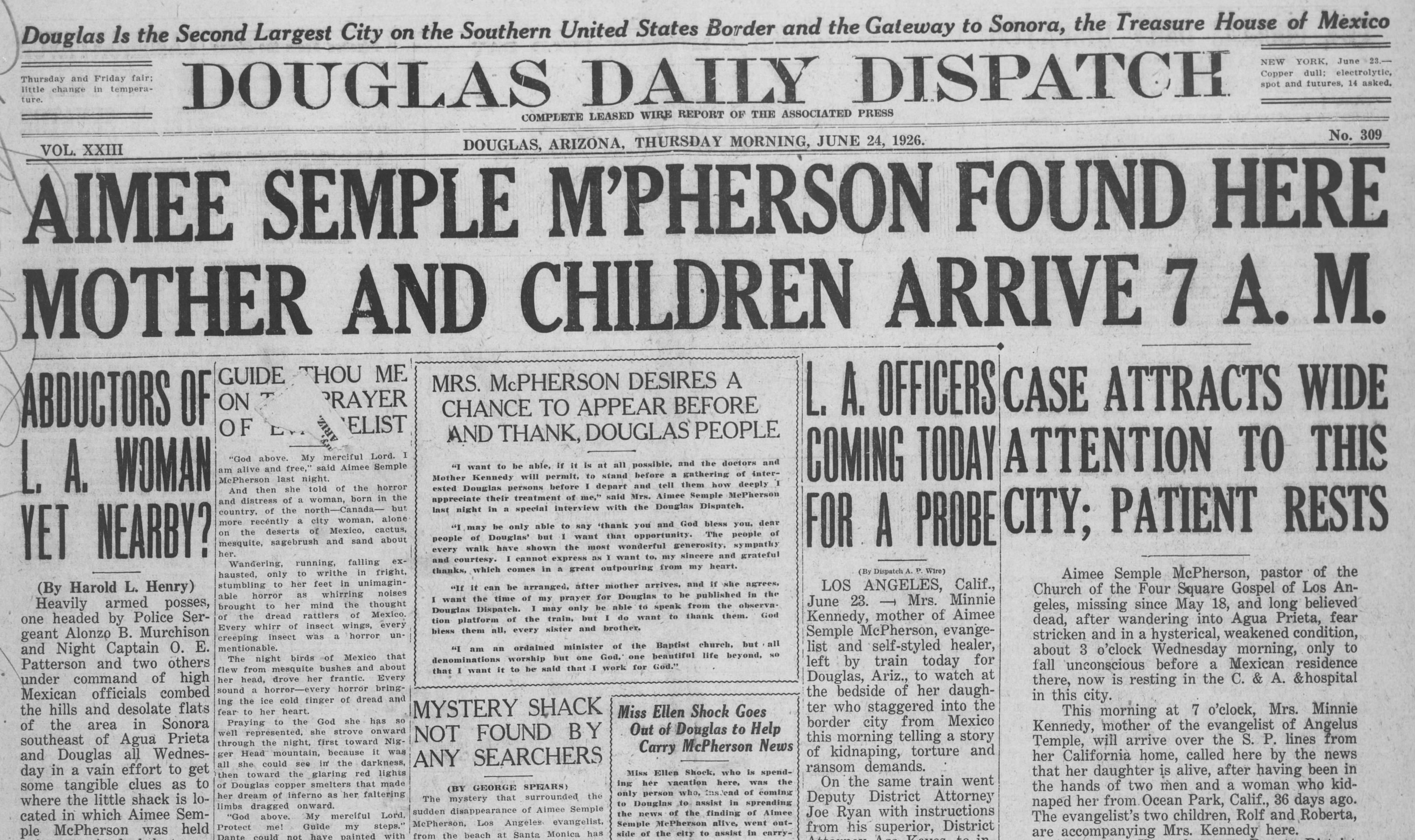
Sister Aimee’s return made headlines around the world. Two competing Los Angeles newspapers, the Times and the Examiner, commandeered airplanes to Douglas so they could be the first to publish photos of the newly discovered preacher; the Times won the race after the Examiner plane had to stop in Tucson to refuel. As Aimee’s mother and her two children boarded a midnight train to Arizona to greet her, hundreds of other reporters invaded Douglas to send back updates from the scene. Western Union reportedly hired eight extra telegraph operators to work around the clock.14 All other business in Douglas ground to a halt while McPherson recovered at the hospital.
In the meantime, the Cochise County sheriff had received a tip that one of Douglas’s outlaw baseball players was causing trouble with McPherson. He asked S.L.A. Marshall, the Copper League treasurer and later an acclaimed military historian, to look into the matter.
In an unpublished section of Marshall’s memoir uncovered by authors Donald Dewey and Nicholas Acocella, Marshall said he confronted Hal Chase at the Crystal Palace Café the next morning and demanded to know why he had visited Sister Aimee at the hospital.15 Chase admitted that he and his landlord, a notorious unlicensed medical provider named Oscar “Doc” Weeks, had cooked up a plan to blackmail the preacher. In Marshall’s version of the story, here is what Chase told him:
It was [Doc’s] idea, really. I was just the messenger. The first visit she wouldn’t talk to me. Said she was too tired. The second time, we got together. So I told her that the Doc and I were ready to swear that she had been in our hands all along instead of in Mexico. She had come to the Doc for an abortion and I had helped him with the operation. Now if she didn’t want this story made public, we would settle for ten thousand dollars. …
She came out of her rocker, looked me straight in the eye and said, “Mr. Chase, let your doctor make his affidavit. Then I will have two doctors examine me and they will swear that I cannot conceive.” That stopped me, and I left the hospital.16
Marshall said he was “equally astounded” by what Chase said next:
Chase paused, squinted hard at me, and asked: “Do you suppose that bitch is so crooked that she would tell me a lie?” He was not trying to make jokes. The question was in dead earnest. His one concern was with whether he had been tricked by Sister, and it seemed not to occur to him that he had confessed to a criminal act. So I put the point to him, and he said: “You’re kidding.”17
According to Marshall, the Cochise County sheriff shrugged off Chase’s ill-conceived attempt at blackmail and he himself believed Chase was “a mental case rather than a crook.”18 Authors Dewey and Acocella also poked holes in Marshall’s “faulty” memories of his time in Douglas a half-century after the fact. Both Chase and Doc Weeks were dead, and no one else was around to corroborate Marshall’s story. But extorting a celebrity like Sister Aimee would not have been out of character for Chase, who was always looking for a quick buck and had zero ethical qualms about where the money came from.
In any event, McPherson’s account of her own kidnapping unraveled just as quickly as Chase’s short-lived plot. Following her sermon in front of a capacity crowd at the Douglas ballpark, Sister Aimee returned home to California the next day to a hero’s welcome. More than 50,000 people greeted her at the train station in downtown Los Angeles and an impromptu parade was held there. She resumed her regular preaching duties at her church and on radio sets around the nation.19
However, the Los Angeles district attorney called for an investigation into the entire incident and McPherson voluntarily appeared before a grand jury in July to tell her story. Prosecutors brought forth numerous witnesses to challenge her account, mostly centering on her alleged affair with her radio engineer, who also went “missing” shortly before Sister Aimee did. He was tracked down in New York with a trunk full of love letters and women’s clothing from some of McPherson’s favorite California stores.20 In the fall, a judge ruled there was enough evidence to charge Sister Aimee with conspiracy and obstruction of justice. A trial date was set for January but prosecutors dropped the charges due to the unreliability of some key witnesses.
McPherson’s kidnapping was never officially solved, and rumors about what happened to her across the border in Mexico continued to swirl for the rest of her life. She remained a popular and influential figure until her death of an accidental overdose at the age of 53 in 1944. Her son took over the Foursquare church’s operations and grew it into an empire that claimed more than 4 million followers in the early twenty-first century. Sister Aimee’s pioneering radio station — which broadcast her sermons from Angelus Temple to followers around the nation at the peak of her popularity — was sold by the church for $250 million in 2003.21
Hal Chase’s baseball season ended abruptly a few weeks after Sister Aimee left town in the summer of 1926. He severely injured his knee in a car crash outside of Silver City, New Mexico. The Douglas team, in financial straits, had accepted an ill-advised offer from local fans to drive the players to all road games in order to save money on travel expenses. Chase returned home to California and continued to hobble around semipro ballfields for a few more years. But his outlaw baseball days were effectively over.22
The Copper League staggered through one final season with some of their major league stars in 1927. Chick Gandil and Lefty Williams remained in the league for the last season, but Buck Weaver left Douglas to return home to Chicago.
One factor in the Copper League’s demise was a visit by baseball commissioner Kenesaw Mountain Landis to El Paso, Texas, in January 1927. In a meeting with Copper League officials, Landis strongly encouraged the league’s cities to apply for admission as a Class D minor league instead of playing as an independent league. In exchange, he demanded that all the teams come together to “stamp out outlawry on southwestern diamonds” — meaning they had to get rid of any players who were banned from professional baseball.23
Most of the teams complied with Landis’s request and, in 1928, the Arizona State League was formed, with teams in Phoenix, Tucson, Miami, and Bisbee. None of the Black Sox were allowed to play ball in the new minor league.
Notes
1 A.G. Mathews, “God Bless You All Keynote of Aimee’s Open Air Address,” Douglas Daily Dispatch, June 26, 1926: 1.
2 “Blue-Chino Game Is Called Off For Evangelistic Meet,” El Paso Herald, June 26, 1926: 7. The Herald said it was the “most original excuse in the history of baseball for the postponement of a regular game.”
3 Gilbert King, “The Incredible Disappearing Evangelist,” Smithsonian Magazine, June 17, 2013, accessed online on May 10, 2026, at https://www.smithsonianmag.com/history/the-incredible-disappearing-evangelist-572829/.
4 Gandil had been playing under an assumed name in La Grande, Oregon, earlier in 1925. After his identity was uncovered, he quickly left for Arizona to begin playing for the Douglas Blues. See Jacob Pomrenke, “Branded by the Black Sox: Ed Brandt’s unlikely rise to the major leagues,” SABR Black Sox Scandal Committee Newsletter, December 2020.
5 Lynn E. Bevill, “Outlaw Baseball Players in the Copper League: 1925-1927,” Master’s thesis, Western New Mexico University, 1988. Accessed online at bevillsadvocate.com on April 5, 2010. O’Connell was banned in 1924 for reportedly offering a bribe to a Philadelphia Phillies player before a late-season game at the Polo Grounds. He claimed he was only doing so at the urging of a Giants coach and three veteran teammates, but he never appeared in another major-league game.
6 Bevill, “Outlaw Baseball Players in the Copper League: 1925-1927.” The teams had agreed to a salary cap of $2,250 per month with a roster limit of 14 players, but the major-league stars could and did demand a higher percentage of their team’s payroll.
7 “Copper League Jottings,” El Paso Herald, August 10, 1926: 5.
8 Bevill, “Outlaw Baseball Players in the Copper League: 1925-1927.”
9 Naomi Grimley, “The Mysterious Disappearance of a Celebrity Preacher,” BBC News, November 25, 2014, accessed online on May 10, 2026, at https://www.bbc.com/news/magazine-30148022.
10 Grimley, “The Mysterious Disappearance of a Celebrity Preacher.”
11 Claire Hoffman, Sister, Sinner: The Miraculous Life and Mysterious Disappearance of Aimee Semple McPherson (Farrar, Straus and Giroux, 2025), 219-221. Page numbers are from the e-book edition.
12 Hoffman, 223-227.
13 Hoffman, 223-227.
14 Hoffman, 228.
15 Donald Dewey and Nicholas Acocella, The Black Prince of Baseball: Hal Chase and the Mythology of the Game (Sport Classic Books, 2004), 376-379. Dewey and Acocella cite an unpublished section of S.L.A. Marshall’s memoir, Bringing Up the Rear: A Memoir, edited by Cate Marshall (Presidio Press, 1979), found at the University of Texas at El Paso.
16 Dewey and Acocella, 378.
17 Dewey and Acocella, 378-379.
18 Dewey and Acocella, 379.
19 King, “The Incredible Disappearing Evangelist.”
20 Hoffman, 378.
21 Don Lattin, “Popular evangelist elected to head Foursquare Church,” San Francisco Chronicle, June 5, 2004, accessed May 10, 2026, at https://www.sfgate.com/bayarea/article/san-francisco-popular-evangelist-elected-to-2752394.php
22 Bevill, “Outlaw Baseball Players in the Copper League: 1925-1927.”
23 Bevill, “Outlaw Baseball Players in the Copper League: 1925-1927.”

