This article was published in the June 2026 edition of the SABR Black Sox Scandal Committee Newsletter.
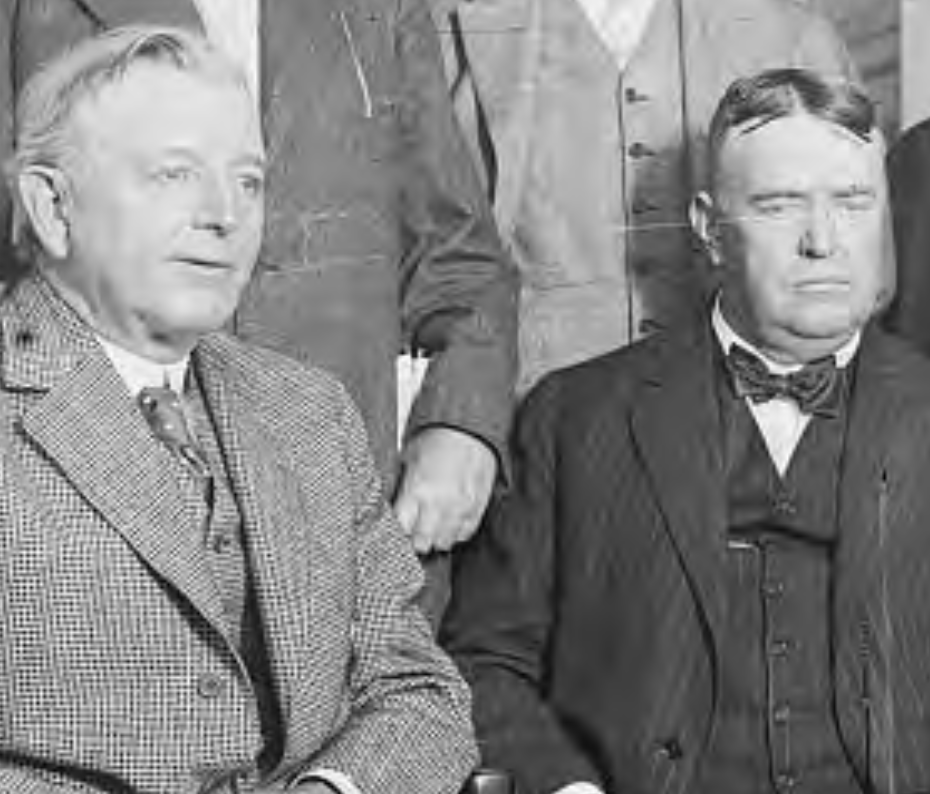
Following their banishment from baseball in the Black Sox Scandal, Shoeless Joe Jackson and two of his former teammates sued the Chicago White Sox for back pay in the early 1920s. The players’ attorneys filed civil lawsuits not in Illinois — but in Milwaukee, Wisconsin.1
Why were these cases filed in Wisconsin? The answer is straightforward: because that’s the state where the Chicago White Sox were incorporated at the time. The Circuit Court in Milwaukee County was the proper court of jurisdiction for a breach of contract complaint against a Wisconsin-based corporation.
But how did the White Sox come to be incorporated in a different state in the first place? That answer is much more complicated, with roots in how Comiskey and his allies helped secretly launch the American League as a rival to the established National League at the turn of the twentieth century.
This basic fact about the team’s business operations was almost universally ignored in contemporary reporting about the Black Sox lawsuits. If any fans or readers in the 1920s wondered why Jackson’s lawsuit against the Chicago White Sox was taking place in Wisconsin instead of Illinois, they could not find the answer in coverage of the case from the Chicago Tribune, Milwaukee Journal, or The Sporting News. The only detail offered in most news articles was that Jackson’s lead attorney, Raymond Cannon, was based in Milwaukee.
Over the past 100 years, most accounts of the Jackson trial have focused on the explosive events that took place inside the Milwaukee courtroom rather than where the proceedings took place. In Eight Men Out, author Eliot Asinof doesn’t mention the location of Jackson’s trial at all. Modern Black Sox historians (including this author) have accurately noted the White Sox were incorporated in Wisconsin but do not explain why. It’s time to set the record straight.
An examination of the White Sox’s historical incorporation records shows that Charles Comiskey and his trusted front-office executives spent a considerable amount of time and effort just before Jackson’s trial began to streamline their operations and ensure any future legal proceedings involving the White Sox would take place in the state of Illinois.
Over the course of three weeks during the winter of 1924, Jackson, Comiskey, and others gave their testimony inside a Milwaukee courtroom. Jackson was seeking more than $16,000 in back pay (about $300,000 in 2026 dollars) after he and the rest of the Black Sox were permanently banned for their roles in fixing the 1919 World Series. Jackson’s civil trial concluded in dramatic fashion. The jury’s verdict went in his favor, awarding him everything he asked for. However, the presiding judge vacated the verdict and charged Jackson and ex-teammate Happy Felsch (a Milwaukee native) with perjury for their contradictory testimony on the stand. Jackson spent an afternoon in a jail cell and went home without a penny.
By that time, the White Sox were no longer incorporated in Wisconsin and Shoeless Joe Jackson’s Milwaukee case soon became an obscure footnote in history.
Founding of the American League
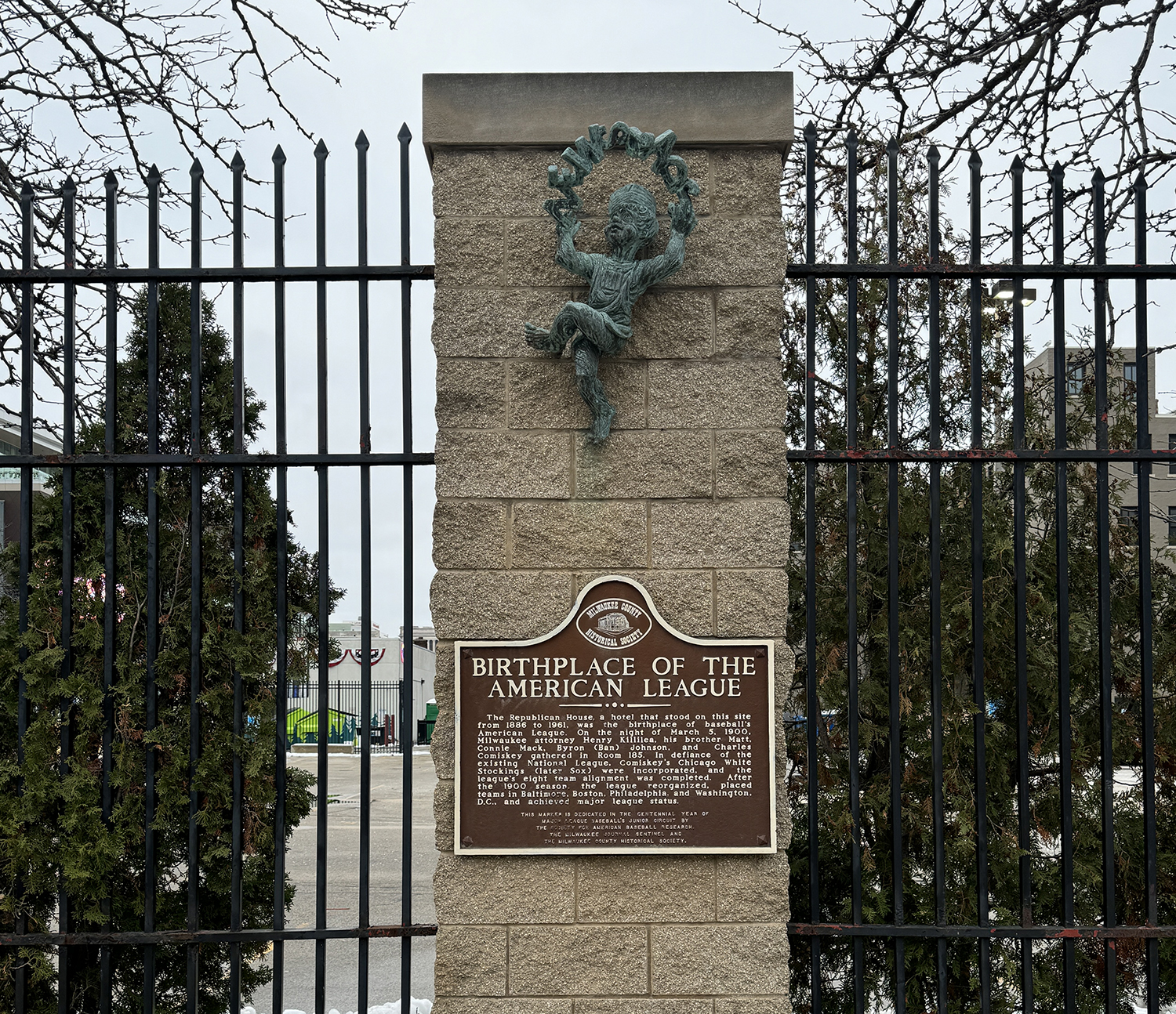
Legally speaking, the franchise known today as the Chicago White Sox came into existence on March 5, 1900. That’s when a secret meeting was held at the Republican House hotel in downtown Milwaukee to formalize the creation of the “American League Base Ball Club of Chicago,” owned by Charles Comiskey.
The American League had not yet played a game. But led by president Ban Johnson, a former newspaper editor from Ohio, the AL had declared war on the existing National League, the only major league circuit to survive professional baseball’s tumultuous decade of the 1890s. The NL was in financial straits and reeling from in-fighting; the league’s owners had voted to contract from 12 teams to eight for the 1900 season. Ban Johnson and his partners, including Comiskey, saw an opening to expand their reach.
Johnson and Comiskey first formed an alliance in 1893, when Comiskey helped Johnson become president and treasurer of a small minor league called the Western League.2 Two years later, with the financial backing of Milwaukee businessman George Heaney, Comiskey bought a Western League team in Sioux City, Iowa, and moved it to St. Paul, Minnesota. Johnson and Comiskey continued to build up the minor league over the next few years, with attendance in Western League cities surpassing some teams in the much larger National League.3
In the fall of 1899, the Western League voted to change its name to the American League and planned to move teams into two major markets, Chicago and Cleveland. Comiskey was still popular in his hometown of Chicago and he wanted to be in charge of a team there.4 James Hart, owner of the National League’s Chicago franchise (now known as the Cubs), had first given his blessing for the American League to place a team in his territory. But as the season drew closer, he changed his mind and warned Johnson that the new league would be in violation of the National Agreement that governed professional baseball if they challenged the NL in such a direct way.5 So Comiskey and Johnson hid their intentions until just before the National League’s winter meeting on March 7–9 in New York.
On Monday, March 5, Comiskey and Johnson set their plan in motion. They traveled by train from Chicago to Milwaukee and gathered at the Republican House hotel with Henry and Matthew Killilea, attorneys and co-owners of the American League’s Milwaukee Brewers. Also present was Connie Mack, the Brewers’ manager who lived at the same hotel.6
Henry Killilea — who later served as counsel to the American League for many years — presided over the meeting and drafted up the articles of incorporation. If Comiskey’s new team was incorporated in Illinois, James Hart would have learned about it immediately and the National League owners might revolt at their upcoming meeting. So they chose to incorporate in Wisconsin instead and keep the news out of the Chicago newspapers for the time being.
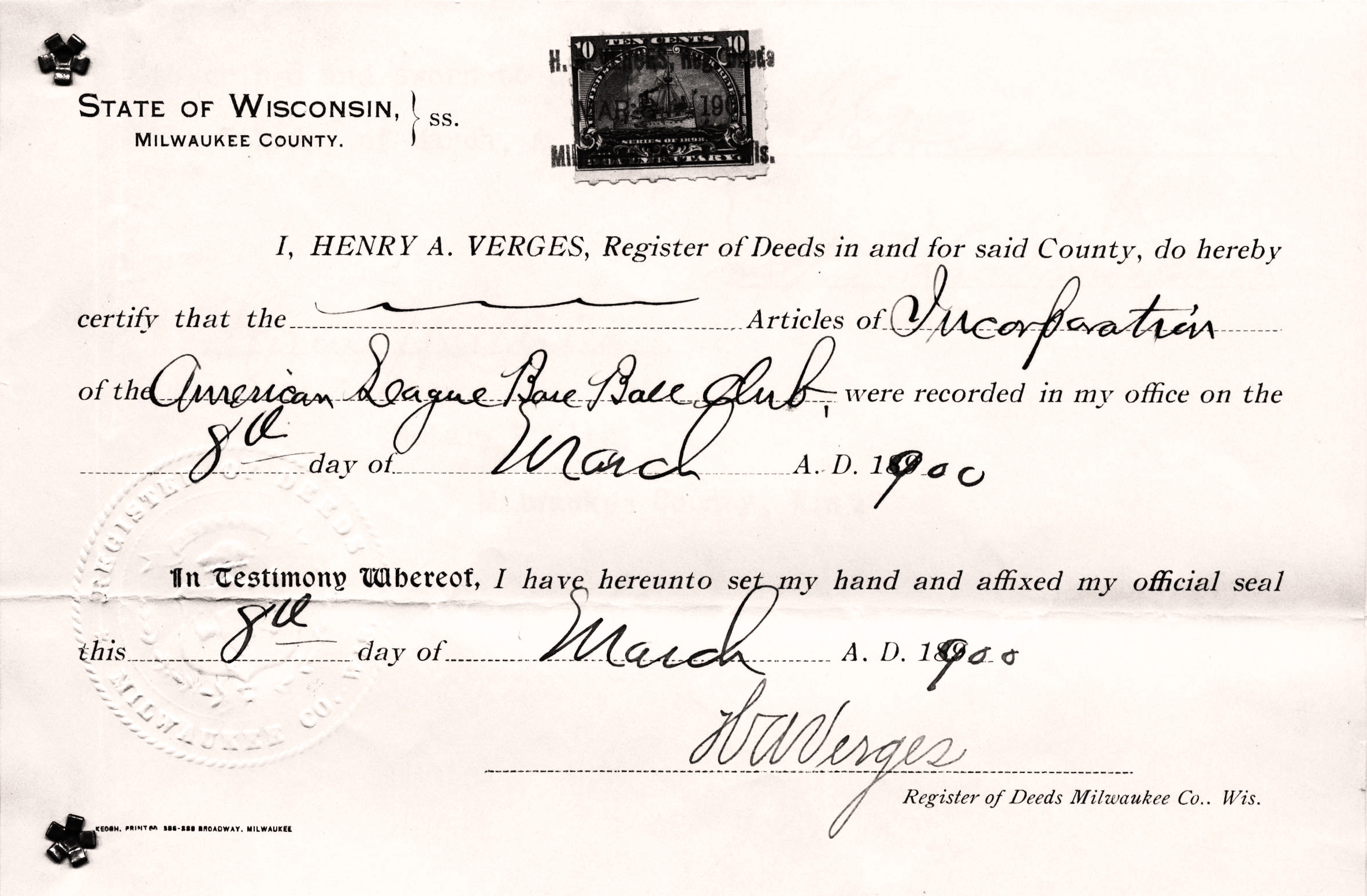
Because Charles Comiskey was not a Wisconsin resident, the papers were signed by three people who were: George Heaney, an insurance magnate and Comiskey’s longtime business partner; William Lachemmaier, who owned a local clothing shop; and Charles Friedrich, an attorney in Killilea’s office.7 The club’s original stockholders were Charles Comiskey and his brother Patrick; the Killilea brothers; and Heaney.8 On March 8, while the National League owners were still meeting in New York, Comiskey’s incorporation papers were recorded by the Milwaukee County Register of Deeds.9
At the American League’s winter meeting one week later, Ban Johnson announced that Comiskey’s team would play at an old cricket club ground, at 39th Street and Wentworth Avenue on the city’s south side. Comiskey had already signed a lease and was busy building a new park in time for Opening Day. James Hart also agreed to a truce, allowing Comiskey’s team to play anywhere south of 35th Street (farther away from the Cubs’ home park) and to call themselves the White Stockings (the former name of his National League club) without violating baseball’s National Agreement.10
On April 21, the White Stockings made their debut at the brand-new South Side Park with a win over the Milwaukee Brewers in front of about 5,200 fans. “Two painters were just beginning work on the fence, and why they did not twist their necks off every time someone hit the ball it is impossible to say,” the Chicago Tribune reported.11 The White Stockings would go on to win the first American League pennant in 1900.
The South Side Park Years
Following the 1900 season, the American League reorganized again and solidified its goal of achieving major league status. New teams were added in four former National League cities and the AL stopped allowing its players to be drafted by NL teams.12 Comiskey’s team in Chicago, whose name was shortened by headline writers to the White Sox13, won a second consecutive American League pennant in 1901 — the circuit’s first season as a major league.
Off the field, Comiskey turned a profit in the team’s second season in Chicago and quickly wiped out the debt he accrued in building South Side Park.14 He bought out the Killilea brothers’ shares — the Milwaukee Brewers had moved their operations to St. Louis — and installed his nephew, Charles A. Fredericks, as secretary-treasurer of the White Sox.15
In 1903, as the American League entered an uneasy peace agreement with the National League and the modern World Series was established, George Heaney sold off his White Sox shares to Comiskey for $10,000, giving the latter full and total control of the ballclub. A few years later, Heaney sued Comiskey in Milwaukee’s Circuit Court and accused the White Sox owner of falsely representing the team’s financial picture. He claimed “Comiskey repeatedly told him that expenses were so heavy as to preclude the possibility of dividends … [and] earnings have been at least $300,000 since the club was organized in 1900.”16 Comiskey countered that he poured all his profits back into the team or to make improvements to the ballpark, and that Heaney got “cold feet” during the lengthy war between the leagues until he decided to sell his shares.17
A judge ruled that the White Sox must open their books18 and Comiskey gave a deposition in which he detailed the inner workings of the club in its early years, including the circumstances of Heaney’s stock sale. A trial date was set and postponed multiple times, and the lawsuit was likely settled out of court years later.19
In the meantime, Charles A. Fredericks, Comiskey’s young nephew and the White Sox team secretary, had been struggling to perform his job due to a series of illnesses. He failed to file an annual report in 1908 and the Illinois Secretary of State canceled the White Sox’s authorization to do business as an out-of-state corporation.20 Nan Comiskey, the owner’s wife, took over as the club’s new treasurer until she handed off those duties to a pair of trusted executives, Harry Grabiner and Norris “Tip” O’Neill.21 It largely fell to Grabiner to pick up the pieces from Fredericks’s absence.
New Ballpark, New Front Office
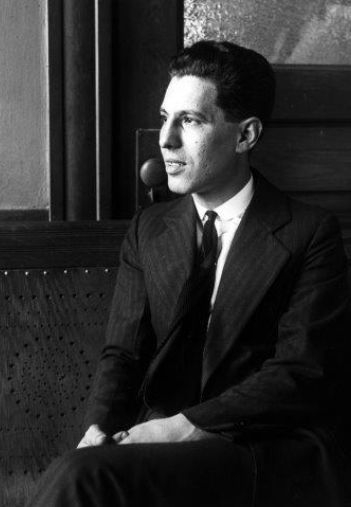
Harry Grabiner, a Chicago native, began his long baseball career at the age of 15 in 1905 when he wandered into South Side Park after a rainstorm and found Charles Comiskey working on the field to get it ready for a game. Comiskey hired him on the spot and Grabiner stayed on the White Sox’s payroll for the next four decades.22
Grabiner’s first job was to sell scorecards at a salary of $50 per month during the White Sox’s World Series championship season in 1906, and he quickly rose through the ranks of the team’s front office, working in ticket sales and learning the business side of the game from Fredericks. When Fredericks became bedridden and stopped coming into the office, Grabiner took over as acting secretary and kept the club’s financial operations running smoothly.
The White Sox’s success during their first decade in Chicago necessitated a move to a larger ballpark. In 1910, they moved a few blocks north to 35th Street and Shields Avenue into a modern concrete-and-steel structure dubbed “The Baseball Palace of the World.” Officially known as White Sox Park, and later Comiskey Park, the ballpark was built in just four months and opened on July 1.23
Charles Comiskey began building a championship roster worthy of their new home. His personnel moves would pay off at the end of the decade with two American League pennants and another World Series title in 1917. Up in the front office, Grabiner continued taking on more financial responsibility, especially after the untimely death of Charles Fredericks — “one of the best known and best liked officials in baseball” — in 1916.24 The 25-year-old Grabiner was named as the team’s secretary soon afterward. In addition to keeping the books, overseeing ticket sales and ballpark operations, and making travel arrangements on the road, Grabiner also became involved in player contract negotiations, a role which would make for a crucial plot point during Shoeless Joe Jackson’s civil trial later.
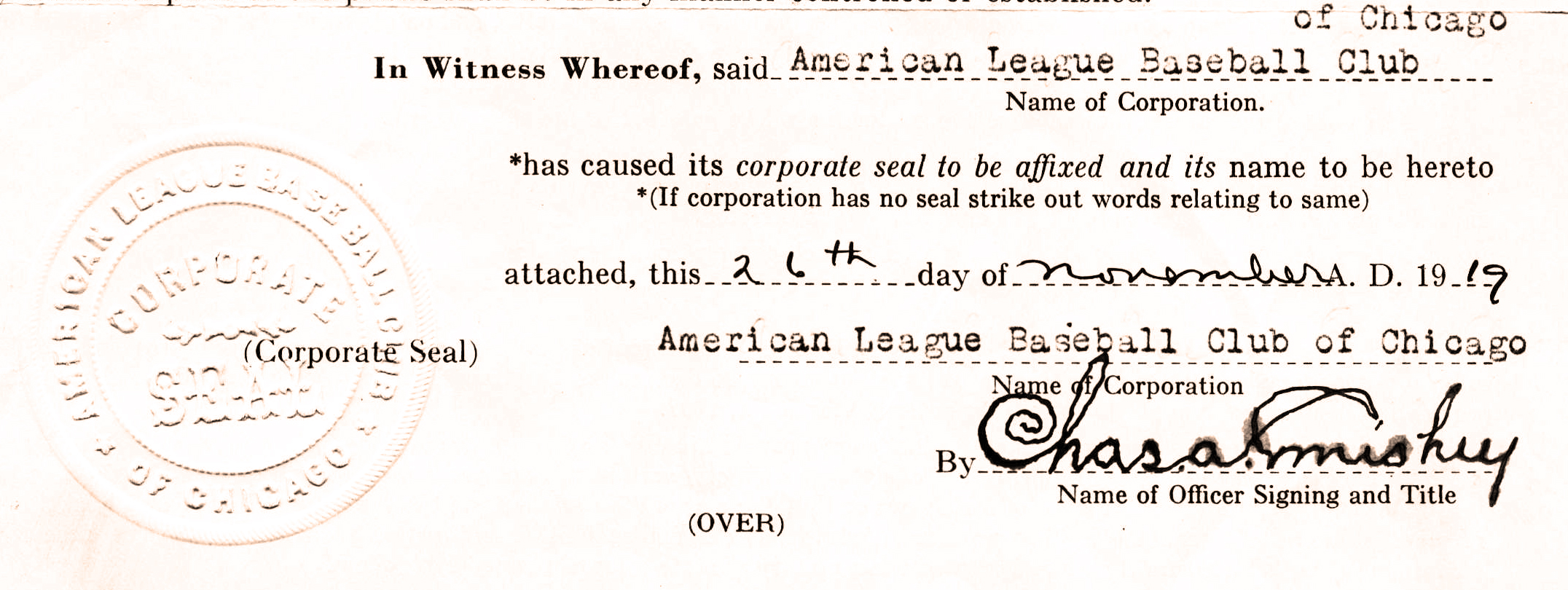
In 1919, a new law passed by the Illinois legislature went into effect to strengthen the state’s ability to punish any companies that failed to comply with the Corporation Act.25 The White Sox had not filed annual reports in either Illinois or Wisconsin for more than a decade. That summer, Grabiner began cleaning up the mess and making sure the club’s paperwork was in order. As the White Sox marched toward the AL pennant and a fateful World Series against the Cincinnati Reds, Grabiner stayed busy with numerous filings to keep the team in good standing with both states.26 The team likely had to pay fines of several hundred dollars to make up for 10 years of noncompliance.27 The Wisconsin Secretary of State reinstated the club’s status in November, a few weeks after the World Series ended.
Incorporating in Illinois
It’s unclear when Charles Comiskey, Harry Grabiner, or anyone else28 involved in White Sox business operations began discussing plans to switch their incorporation from Wisconsin to Illinois. Grabiner was known to keep a private diary which might offer some insights, but those papers disappeared soon after their discovery in a cellar at Comiskey Park decades later.29
Comiskey and Grabiner filed an amendment to the articles of incorporation in the spring of 1922, increasing the club’s capital stock from the original $30,000 to $750,000.30 Grabiner went on to purchase 50 shares and become a minority owner himself.31
That same spring, a firebrand lawyer from Milwaukee named Raymond Cannon filed breach-of-contract lawsuits against the White Sox on behalf of Shoeless Joe Jackson, Happy Felsch, and Swede Risberg, who were permanently banned from playing professional baseball for their roles in fixing the 1919 World Series. (A separate case was also filed by Buck Weaver’s attorney.) Jackson was seeking $16,000 in damages for the three-year contract he had signed before the 1920 season and lost the chance to fulfill when he was suspended.
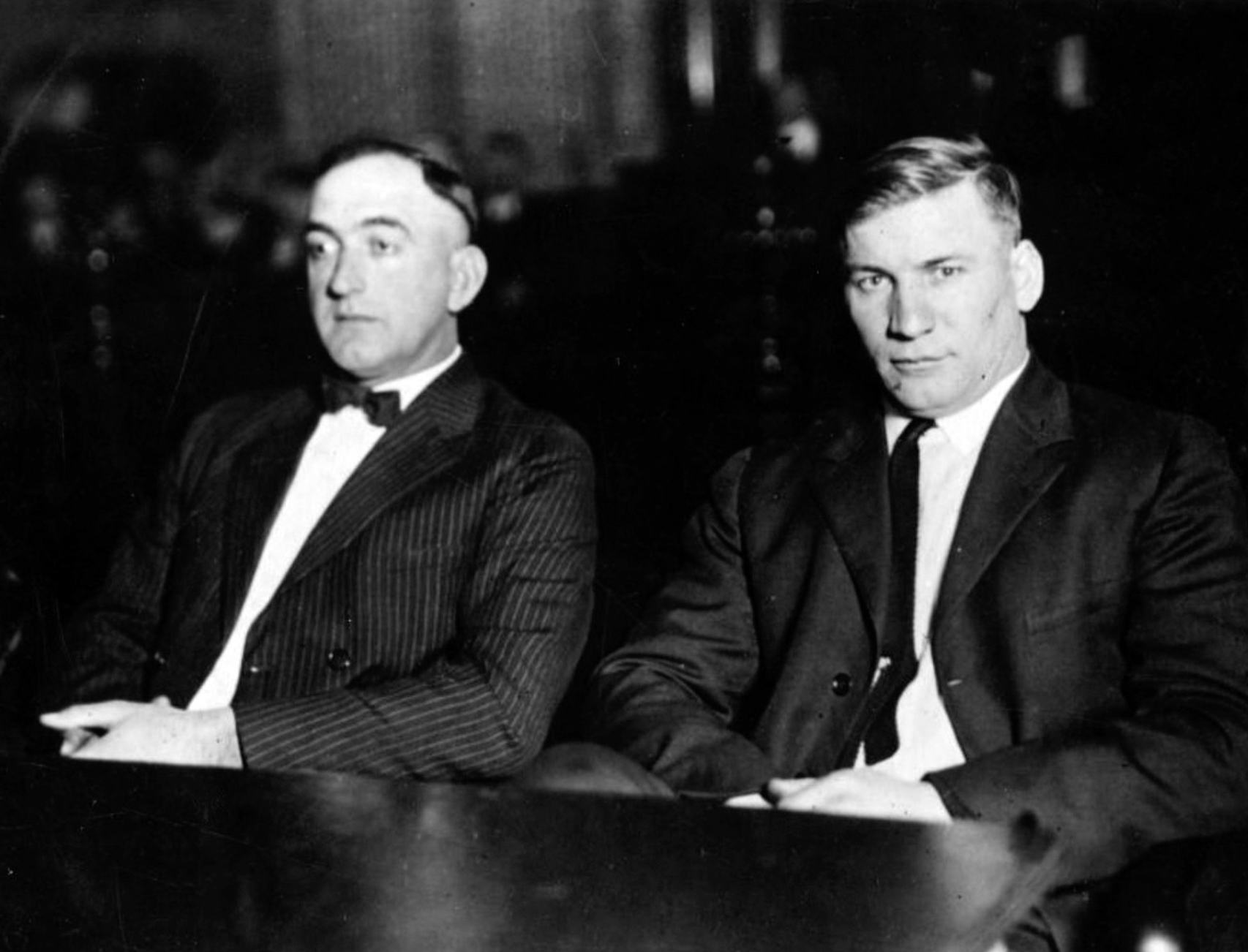
Only Jackson’s case went to trial. Comiskey hired Milwaukee-based attorneys George B. Hudnall and Frank McNamara to represent the team as defense counsel.32 In the meantime, he and Grabiner set out to dissolve the club’s legal connection with the state of Wisconsin. On October 4, 1923 — as the baseball team wrapped up its final home game of the season at Comiskey Park — the White Sox filed articles of incorporation in Illinois for the first time.33 In early December, Comiskey and Grabiner signed the papers to decertify the American League Base Ball Club of Chicago as a Wisconsin-based corporation.34
By the time Jackson’s trial began a few weeks later on January 29, 1924, at the Milwaukee County Courthouse, the Chicago White Sox were finally able to call Illinois home, both on and off the field.
Chicago White Sox, Inc.
Even though their on-field fortunes fell dramatically after the Black Sox Scandal, the next few decades were a period of relative stability for the White Sox as an organization.
Harry Grabiner remained in charge of the business and baseball operations through the deaths of Charles Comiskey, the team’s founder, in 1931 and his son, J. Louis Comiskey, in 1939. Lou Comiskey’s will directed the White Sox to offer Grabiner a 10-year guaranteed contract to stick around. But Grabiner clashed with Lou’s widow, Grace Comiskey, who had taken over as team president. Grabiner resigned in 1945 and then resurfaced as general manager of the Cleveland Indians after future Hall of Fame executive Bill Veeck bought the team. However, Grabiner suffered a serious stroke and died at the end of the 1948 season. He did not see Cleveland win the World Series that year.35
Grace Comiskey’s 17-year tenure as White Sox president ended with her death in 1956. She left the team to her oldest daughter, Dorothy Comiskey Rigney, instead of her son, Chuck Comiskey II.36 A family feud erupted that resulted in Dorothy selling her majority stake in the team to Veeck and Hall of Fame first baseman Hank Greenberg. Her brother Chuck sued to stop the sale — as the team’s largest single shareholder, he was angling for a local insurance salesman named Charles O. Finley to control the White Sox instead37 — but Veeck and Greenberg won the war.
The new owners did their best to keep Chuck happy, letting him keep his office and even raising his salary while the White Sox were on the way to winning their first American League pennant since the Black Sox Scandal in 1959. But Chuck sued Veeck and Greenberg too, and the entire saga was called “baseball’s strangest stalemate” by one newspaper.38
Veeck’s poor health forced him to sell the White Sox after just two-and-a-half seasons. He and Greenberg sold their shares to Arthur and John Allyn for $2.5 million in the summer of 1961. In an ill-advised bid to regain control, Chuck sold his shares to a different group and cut off the Comiskey family’s stake in the Chicago White Sox for good.39
The Allyns also made a lasting change to the way the White Sox were structured. In December 1961, they changed the name of the corporation from American League Base Ball Club of Chicago — which Charles Comiskey first registered in a secret meeting in Milwaukee at the turn of the twentieth century — to Chicago White Sox, Inc.40 On June 7, 1962, the Allyns filed articles of dissolution to close Chicago White Sox, Inc., just a few weeks after they transferred ownership to the Artnell Company, a holding company created by their father.41
Acknowledgments
Special thanks to archivists Jon Hunter of the Wisconsin Historical Society and Eowyn Montgomery of the Illinois State Archives for their help in locating Chicago White Sox incorporation records in both states.
Notes
1 For more background on the Joe Jackson back-pay lawsuit, see William F. Lamb, Black Sox in the Courtroom: The Grand Jury, Criminal Trial and Civil Litigation (McFarland & Co., 2013); Gene Carney, Burying the Black Sox: How Baseball’s Cover-Up of the 1919 World Series Fix Almost Succeeded (Potomac Books, 2006); and Jacob Pomrenke and David J. Fletcher, eds., Joe Jackson, Plaintiff, vs Chicago American League Baseball Club, Defendant: Never-Before-Seen Trial Transcript (Eckhartz Press, 2023).
2 Joe Santry and Cindy Thomson, “Ban Johnson,” SABR BioProject, accessed May 27, 2026.
3 Bob Buege, “The Birth of the American League,” Baseball in the Badger State (SABR, 2001), accessed May 28, 2026.
4 Irv Goldfarb, “Charles Comiskey,” SABR BioProject, accessed May 28, 2026.
5 Mike Lynch, “1899-1901 American League Winter Meetings: War on the Horizon,” in Baseball’s 19th Century Winter Meetings: 1857-1900, Jeremy K. Hodges and Bill Nowlin, eds. (SABR, 2018), accessed May 28, 2026
6 Buege.
7 “Articles of Incorporation of the American League Base Ball Club of Chicago,” March 5, 1900, held by the Wisconsin Historical Society. Charles Friedrich is sometimes misidentified as Charles A. Fredericks, Comiskey’s 23-year-old nephew who later became the White Sox team secretary. But incorporation in Wisconsin required all signees to be residents of the state, which is why neither Fredericks nor Comiskey were included.
8 Patrick Comiskey, who served as treasurer of his brother’s St. Paul Saints team and worked in the state insurance commissioner’s office in Minnesota, died of Bright’s disease on April 19, 1900, just a month after the White Sox were incorporated. See “Patrick Comiskey Dead,” St. Paul Globe, April 20, 1900: 2.
9 “Recorded Articles of Incorporation,” March 8, 1900, held by the Wisconsin Historical Society.
10 Buege.
11 Ken Carrano, “Schorling Park (Chicago),” SABR Biography Project, accessed June 2, 2026. See “Brewers Win Opening Game,” Chicago Tribune, April 22, 1900: 17.
12 Lynch.
13 Ed Coen, “Setting the Record Straight on Major League Team Nicknames,” SABR Baseball Research Journal, Fall 2019, accessed on June 4, 2026.
14 “Gives Early History of Sox,” Chicago Tribune, December 4, 1908: 11. According to Comiskey’s deposition in the George Heaney lawsuit, Comiskey did not take a salary during the 1900 season.
15 “Comiskey is Re-Elected,” Chicago Tribune, October 14, 1902: 13.
16 I.E. Sanborn, “Heaney Sues for White Sox Stock,” Chicago Tribune, December 7, 1907: 6.
17 Sanborn.
18 Chicago Inter Ocean, January 5, 1908.
19 “Comiskey in Baseball Suit,” New York Times, January 23, 1910; “White Sox Baseball Suit Up in January,” Milwaukee Daily News, November 24, 1911: 8. The latter article is the last known reference to Heaney’s lawsuit in any Chicago or Milwaukee papers. The most likely conclusion to the saga was an out-of-court settlement.
20 “Certificate of Cancellation of Authority to Transact Business in Illinois,” April 15, 1908, held by the Illinois State Archives.
21 “Annual Report of the American League Base Ball Club of Chicago,” October 18, 1907, held by the Wisconsin Historical Society. Nan Comiskey was elected as White Sox treasurer in 1907, but the club failed to file any annual reports between 1908 and 1918.
22 Steve Cardullo, “Harry Grabiner,” SABR Biography Project, accessed June 4, 2026.
23 Bob LeMoine, “July 1, 1910: ‘Baseball Palace of the World’ opens with White Sox’s first game at Comiskey Park,” SABR Games Project, accessed June 4, 2026.
24 Sam Weller, “C.A. Fredericks Dies After Long Illness; White Sox Official,” Chicago Tribune, January 12, 1916: 11. The Tribune also reported, “When Fredericks was taken ill in the fall of 1911, Comiskey declared there never would be another secretary of the White Sox as long as the boy lived, and the Old Roman has kept that pledge.”
25 “Corporations Must Report on Business,” Illinois State Register, January 15, 1920: 10.
26 “Annual Report and Application for Reinstatement,” July 31, 1919, held by the Illinois State Archives; “Change of Agent or Place of Business in Illinois,” August 26, 1919, held by the Illinois State Archives; “Annual Report of the American League Base Ball Club of Chicago,” November 26, 1919, held by the Wisconsin Historical Society. Curiously, in the change-of-agent form on August 26, Grabiner listed the team’s primary office at 343 S. Dearborn Street in Chicago — inside the Fisher Building, where the American League office under Ban Johnson was located. In all other filings, the White Sox’s place of business was listed at 35th St. and Shields Ave., the site of Comiskey Park.
27 “Affidavit of Failure to File Annual Reports,” November 26, 1919, held by the Wisconsin Historical Society. In news articles about the updated Corporation Act laws that went into effect on July 1, 1919, the Illinois Secretary of State could charge a $20 penalty for each report that was not filed on time, plus a penalty of 10 percent added to the amount of franchise tax owed, not to exceed a fine of $1,000. It is unclear exactly how much the White Sox had to pay when they filed for reinstatement in November 1919.
28 In the White Sox’s 1920 annual report, two new names were included as club officers for the first time: Carey W. Rhodes and Alfred S. Austrian, who were both attorneys at the Chicago office of Mayer, Meyer, Austrian, and Platt. Austrian served as the White Sox’s longtime corporation counsel. Comiskey’s son, J. Louis Comiskey, was named as the team’s treasurer. See “Annual Report of the American League Base Ball Club of Chicago,” January 2, 1920, held by the Wisconsin Historical Society.
29 As Steve Cardullo explains in his SABR BioProject article, cited above, “Few knew of the Harry Grabiner diary’s existence until it was discovered by Bill Veeck’s nephew Fred Krehbiel, a White Sox employee, in the cellar of Comiskey Park in 1963. Veeck, who owned the White Sox from 1958 to 1961, revealed some of the diary’s contents in his 1965 book with Ed Linn, The Hustler’s Handbook.” For more on Krehbiel’s discovery, see “Harry’s Diary: The Elusive Missing Link,” by Dr. David Fletcher and Paul Duffy in the SABR Black Sox Scandal Research Committee’s June 2013 newsletter.
30 “Amendment to Articles of Incorporation of the American League Base Ball Club of Chicago,” April 12, 1922, held by the Wisconsin Historical Society.
31 Harry Grabiner’s Chicago White Sox stock certificate, dated November 27, 1923, showing he had purchased 50 shares at a par value of $100 each, was sold by Heritage Auctions in 2006.
32 Hudnall and McNamara were attorneys at the Milwaukee office of Bottum, Hudnall, Lecher, and McNamara. Another Chicago-based attorney, John C. Northrup, also served as co-counsel for the defense.
33 “Articles of Incorporation of the American League Base Ball Club of Chicago,” October 4, 1923, held by the Illinois State Archives. A separate affidavit to withdraw the White Sox as a registered foreign (out-of-state) corporation in Illinois was also filed that day.
34 “Dissolution of Corporation of the American League Base Ball Club of Chicago,” December 4, 1923, held by the Wisconsin Historical Society.
35 Cardullo.
36 John Rosengren, “Buying the White Sox: A Comic Opera Starring Bill Veeck, Hank Greenberg, and Chuck Comiskey,” The National Pastime: Baseball in Chicago (SABR, 2015), accessed June 4, 2026.
37 Rosengren. Finley later bought the Kansas City Athletics and moved them to Oakland, California.
38 Rosengren, citing the Detroit News, March 12, 1961.
39 Warren Corbett, “Bill Veeck,” SABR Biography Project, accessed June 5, 2026.
40 “Amendment to Articles of Incorporation of American League Base Ball Club of Chicago,” December 28, 1961, held by the Illinois State Archives.
41 “Articles of Dissolution of Chicago White Sox, Inc.,” June 7, 1962, held by the Illinois State Archives.

